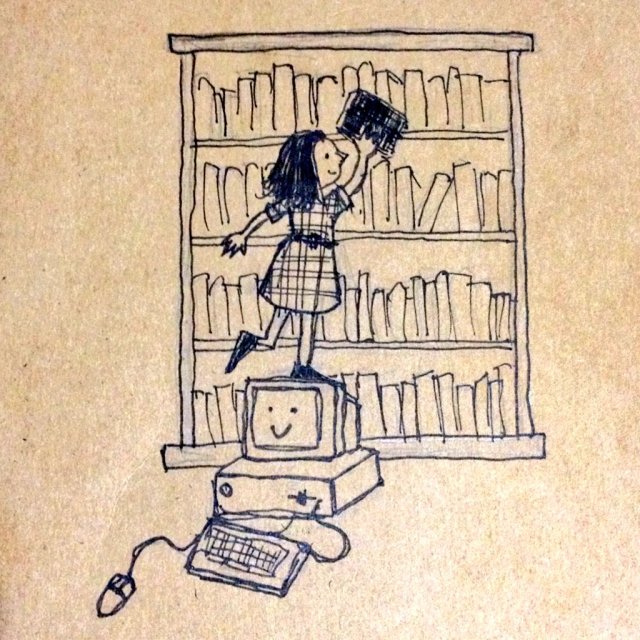
The Library Nerding has begun…

I started my RMIT Information Management course this evening.

My first subject is The Digital Information Environment. Our first assignment is to create a Google Sites website to act as a portfolio of our work and reflections for our course.

There’s a certain irony in a subject dedicated to managing digital information asking  you to set up yet another website. My digital wake is strewn with the wreckage of forgotten websites and neglected social media accounts. In their proliferation is their doom. One person can only maintain so many sites.

I did ask if I could use Library 3000 instead. I was told no–we’d need to use some of the plugins offered by Google Sites later in the assignment.

This is my skeptical face. :/

Anyway: here’s three ideas I took away from my first class.

#1 – What is a document, anyway?

Information Management could be described as the science of storing documents in such a way that people can find them again. But what actually is a document?

The lecturer flashed up several attempts at a definition, none of which seemed all-encapsulating.

I’m okay with this. Ever since I read about fuzzy sets, I’m perfectly happy to describe something as clearly a document, document-ish, or only vaguely document-like. The core idea is that a document is a discrete physical or logical object that contains information.


The discrete bit gets messy with digital documents: a single webpage can be made up of multiple files (content, stylesheet, images) plus interactive code, live database search results, etc. etc.

Regardless, a document usually has:

  • Content: the information within the document
  • Structure: the way the information is organised
  • Presentation: the media, format and appearance of a document, and
  • Context: when, where, why, how the document was created and changed

These traits overlap: the content may only be meaningful based on the context, the presentation may subtly change the content, etc.

#2 – I could go study at RMIT Vietnam

RMIT have a Vietnam campus. And you can study abroad there as one of your Masters electives. They even have a tilt-shift marketing video.

Apparently the library there is very high-tech, but they also face a lot of censorship issues because of the Vietnamese government.

I intend to ask lots of questions about this. I’ve never been to Vietnam. I think this would be a really interesting way of exploring my Big Question in a very different context to Melbourne.

#3 – Random Study Tips

The quickest, easiest way to read and understand a handout is to go through it with a highlighter pen.

Reuse, reuse, reuse: if you’ve got a clear structure for writing an essay or building a website, reuse it mercilessly. The content is what matters. Don’t waste brainspace trying to think up how to structure it.

Talk to your lecturers and the other students. Sit in the front row. Be excited. This isn’t high school. No one cares if you’re cool or not.

Posted in Uncategorized | Leave a comment

The Zine Collection, State Library of Victoria

I got to explore the State Library of Victoria’s zine collection yesterday. I’ve added my photos and comments at the bottom of my (rather long) Secrets of the State Library Victoria storify.

This is a collision of two things that I love: zines and libraries.

Actually, it was a collision of three things that I love: zines, libraries, and going behind the scenes in a public institution. There’s a specific type of magic in peeking behind the curtains. I get genuinely excited to see the dull grey compactuses of the storage rooms.

This is why I’m becoming a librarian.

Speaking of zines, and books, and the creatures that love them: I’ve created a PDF version of my Introducing Booklice zine. Because the world needs to learn about these little cuties.

Download it here: booklice_zine_pdf

Posted in please do not study | Leave a comment

Ex Libris – the PDF version

I’ve been neglecting this blog while I frantically try to finish off a number of personal projects before I start my studies in February.

One of those projects will be holding a stall at the Festival of the Photocopier 2017 zine fair. I’ve made a brand new zine for this (called TALL SAD GIRL AND SHORT PUNK GIRL ARE FRIENDS), and I’m hoping to have preview copies of my self-published grunge-rock ghost novel The Stray Swans for sale there too.

All of which is an elaborate lead-in to saying: I’ve made a PDF version of Ex Libris, my zine/mini-comic about my life-long love of libraries.

You can download a copy here: ex_libris_a7

Let me know what you think.

Posted in please do not study | Leave a comment

“…the use of data as a shackle rather than a tool.”

The branch supervisor at the East Lake County Library in Florida has been suspended for creating a fake patron record and using that to check out books that are in danger of being culled for lack of use.

Libraries weed books. It’s sad, but necessary. Storage space is not infinite. In order to optimise their services, libraries will often weed books that have not been used in a long time. And software systems are very good at tracking usage, and thus reporting on which books to dispose of.

The problem, as Boing Boing points out, is that statistics are a) not unbiased and b) lack insight and broader contextual understanding.

For example: the suspended branch supervisor, George Dore, used the fake patron account because he wanted to save the library from having to re-purchase books that he considered would become popular again.

Theoretically, this is what you pay librarians for. But in the money wars between governments and service providers, insight and context lose out to raw data. As Boing Boing state:

The problem here isn’t the collection of data: it’s the blind adherence to data over human judgment, the use of data as a shackle rather than a tool. As the article in the Orlando Sentinel hints, this is because “money wars” have made enemies out of the city and its librarians — and as this episode highlights, there is no good way to proceed amidst that enmity. Just as treating teachers as lazy welfare bums who must be measured with standardized tests has lowered educational standards and driven out the best teachers, so will any other system that treats employees as problems rather than solutions engender a continuous, spiraling arms race that will never solve the problem.

The idea worth stealing here is: do not blindly trust the data – run it past the experts first.

Posted in ideas worth stealing, Uncategorized | Tagged , , | Leave a comment

Acceptance

Congratulations David

You have been offered a place at RMIT University for Semester 1 2017 in:

Program: GC098 Graduate Certificate in Information Management
Study load: Part-time
Fee type: Full-fee
Campus: City
Available sequence: MC196 – Master of Information Management

I’m going to be a library nerd!

(I have to start with a Grad Cert for bureaucratic reasons, but the aim is to get my Masters.)

Posted in library nerding | Tagged , , , | Leave a comment

Ideas worth stealing: PAX AUS

I spent today at PAX Australia.

PAX is a video games convention. And video games conventions may not seem particularly relevant to a library blog. But one of the things I want to do with this blog is collect ideas from different fields that might be of use to my career in library nerddom.

This was my first time at PAX. It’s huge.

It filled out the entire Melbourne Exhibition Centre. I actually had a bit of panic attack when I entered the main hall full of crowds and queues and lights and noises. As I twittered replicates the gaming experience in that I’m lost & have no idea what I’m doing & a monster is probably about to eat me…

It took me almost an hour to find my bearings and gain some composure. Part of that was sitting down and reading the map. And part of it was just jumping into the experience: playing a game, talking to booth staff, focusing on the bit of the convention that was right in front of me, rather than trying to take it all in at once.

I’ve storyfied my tweets from the convention, so I won’t spend time here on describing it. But here are some key ideas I took away:

Get Hands-On

Video games are a digital medium, and yet they can pack out a convention centre. Part of the appeal, I think, is just getting a hands-on experience with stuff. You get to play the games, talk to the devs, try out the gear.

Humans don’t just learn by reading and thinking. We learn by doing.

Serendipity

I caught up with a friend I hadn’t seen for 20 years just because we were in the same location. I bought a game that I would not have even known existed if I hadn’t walked past the booth and thought it looked cute.

Physical proximity allows these sort of chance connections to happen.

Inclusivity

If you follow gamer culture, you’ve probably heard about GamerGate, the vicious backlash against feminism (and women in general) in video games. The victims of GamerGate have banded together to make gaming more welcoming, diverse and inclusive. The organisers have done a great job of listening to this community and making PAX a safe and inclusive place.

They had:

Gathering the Community

I loved seeing the cosplay. I loved chatting to developers as I tried out their games. I loved meeting friends. I loved just being around all these people enjoying what they loved. These things can only happen when people gather together in the same physical space.

There is a huge value in providing a place where people can gather together.

Posted in ideas worth stealing | Tagged , | Leave a comment

New Zine

exlibris_copies

I’ve made a new zine. If you’re in Melbourne and would like a copy, ask me.

(If you’re not in Melbourne and would like a copy, ask me anyway. We can probably work something out.)

Posted in please do not study | Tagged , , | Leave a comment

Career as a Question

Why do I want to study Information Management?

In my first post on this blog, I gave my personal, introspective answer. This post is my “professional” answer, the one focused on the future and the outside world.

First, some background:

I’ve worked in tech support for almost all of the 20 years of my working life. I started as a lowly helpdesk minion who had never used Windows, and have worked my way up to be the IT manager for the student union at the University of Melbourne.

I’ve enjoyed the technical challenges, and I love helping people. But I don’t want to be running a helpdesk when I’m 60. One of the goals I set myself for this year was to plan out a change of career direction.

Values

I have some very clear values that I look for in any organisation that I work for. They are:

  1. Contributing to the social good
  2. Collaboration and sharing, not competition
  3. Fairness towards staff (equality, diversity, a respect for the work/life balance)
  4. The use of technology to help people achieve all the above

To help me rethink  my career, I used my list of values to make a list of the type of organisations that would be most likely to share them: educational institutions, healthcare, social services, government, NGOs, and libraries.

When I wrote that last item down, a light went off in my head.

My first post explains why:  I have a long history and a deep emotional connection with libraries. But a deep emotional connection is not a career. I needed to think in practical terms what working in libraries would mean.

I spent a lot of time talking to the librarians I know, asking them about their careers and where they saw libraries going. And through those conversations, I narrowed it down little. I knew I wasn’t interested in “putting books back on the shelf”. I didn’t want to be a children’s librarian, or an archivist. I wanted to use my IT experience to improve people’s access to libraries, but I couldn’t solidify that down into a specific role.

Until, over lunch, it hit me.

Career as a Question

I couldn’t think of a specific role because I didn’t want a specific role. What excited me was the question:

How can we use IT to improve access to library collections and resources?

The moment I wrote that down, everything clicked into place. It wasn’t just a question, it was The Question, the single question that clarified how I could use my experience in IT to service the libraries that I love.

The Question opened up a huge variety of roles that would involve trying to answer it: contractor with software vendors, interface designer, project manager, IT architect embedded in an institution, consultant, cross-training at galleries and schools, research, teaching…

And in The Question I could see the shape of my career, as clearly as the level progression of a character in Dungeons & Dragons:

  • Apprentice: studying information management, learning what systems are currently in place
  • Journeyman: applying and refining my learning in the real world
  • Master: teaching and mentoring others
  • Wizard: growing a long white beard, saving the world with the power of books.

(I thought that last one was just a joke, until I read a speech by Chris Bourg, MIT’s Director of Libraries, about how libraries can save us.)

I finished my pizza buzzing with excitement. Career as Question, I joked to myself. But that question brought everything into focus.

Questions within Questions

After my lunchtime revelation, I went back to my office and did what every grown adult does when planning the rest of their lives: I made a multi-coloured mind map. I wanted to capture some of the other questions that flow from the original.

Mindmaps aren’t very accessibility-friendly, so I’ve reproduced it below as a nested list.

  • How can we use IT to improve access to library collections and resources?
    • What is being done now?
      • What works well? What doesn’t?
      • What is missing?
      • What ideas can we steal from other fields?
    • What does “improve” mean?
      • What do patrons need? How do we know this?
      • How do you measure improvement?
      • How do we remember what was tried and failed?
    • What tools are there?
      • How do we deploy them effectively?
      • What is the future(s) of libraries, and how do we build for that?
      • How do we work within limited budgets?
      • How do we develop new tools, and integrate existing ones?
    • What skills are needed?
      • How do we acquire those skills?
      • How do we stay up to date?
      • How do we pass those skills on?

There’s a lot of questions there. And there are probably a million more that I’m too much of a library noob to even know that I should ask them.

But I felt like I was on the right track when MIT released their report on the Future of Libraries, and it addressed exactly these issues.

The Inevitable Problems

I was, perhaps, a bit too giddy with excitement about distilling my career plans down into a single question. So it was a useful reality check when I showed my multi-coloured mind map to RMIT’s Program Manager for the Masters of Information Management.

This looks like a Master by research, he said. Maybe even a PhD.

Hold up, I answered. I am a level 0 Library Nerd. I know nothing about libraries at the moment. I need to actually learn how things work before I race ahead and try to reinvent them.

Another problem: framing my career goals as a question can confuse people into thinking that I’m only interested in researching the answer.

Research will be a part of my career, I have no doubt. But mostly I’m excited about answering The Question by doing it; using IT to improve access to library collections.

And look – it’s entirely possible that in studying information management I will discover the perfect role for me, and my career goals might change. I’m not shutting those doors closed forever.

I suspect my goals won’t change, though. The more I think about The Question, the more right it feels.

It doesn’t just feel like an exhilarating career.

It feels like a life well lived.


Next post: I’m going to make a dad-pun about SWOT and swotting, and talk about my strengths, weaknesses, threats and opportunities in studying information management.

Posted in library nerding | Tagged , , , , , | 2 Comments

Library goals

library_goals

My goal: using IT to improve access to library collection and resources

Posted in please do not study | Leave a comment

Libraries: a personal history

This afternoon, I applied to the Masters of Information Management program at RMIT.

I think that means I’m a Level 0 Library Nerd.

As part of the application, I had to write a personal statement about why I wanted to study information management. I gave them the proper, professional answer, which I’ll get to in another post. But this is the first post on this blog, so I wanted to write a personal personal statement.

By which I mean: my personal history with libraries.

The first library I remember: the Heatherdale Primary School library, a separate orange brick building next to the asphalt sports area. I discovered Asterix and Tintin there, and later John Christopher’s The Death of Grass and Susan Cooper’s The Dark is Rising. I also remember sitting at one of the tables in there as I filled out the order form in the Book Club catalogue for a strange-sounding book called The Warlock of Firetop Mountain, which lead to a whole different sort of nerdery.

Heatherdale Primary is gone now, replaced by suburban townhouses. I don’t know what happened to the library books.

The Nunawading Public Library is still there, although it’s been decades since I last visited. That’s where I used to borrow books about marine biology, and BASIC computer programming. I wanted to be a marine biologist as a child. Somehow the computers won.

High School: Wesley College, Glen Waverley campus. Late afternoon sunlight streaming through the library’s large glass windows. Browsing idly, I find a book called Shadowlands by Peter Straub. The cover is a large owl swooping out of a man’s coat. It’s a dark and troubling story, about the price of magic and danger of fairytales. It still haunts my imagination.

University. The Warlock of Firetop Mountain leads to Dungeons & Dragons, which leads to Call of Cthulhu. My friends and I scour the shelves of the Baillieu Library for esoteric lore that we can use in our campaigns. I find The Golden Bough, and Frazer’s neat classifications of sympathetic and imitative magic.

University is also where I discover the Rowden White Library, my favourite of all libraries. There are signs on the desks requesting that students “please do not study“. The RWL’s Calvin and Hobbes collection leads me to The Dark Knight Returns, and then The Sandman: A Doll’s House and Love and Rockets. My lifelong love affair with comics begins here.

The Rowden White is also where I discover Iain Banks. As I wrote when he announced that he had terminal cancer, Banks isn’t merely influential on my goals as a writer, he’s definitional.

And one of my most precious memories of the RWL: in 1991, I’m one of a dozen people who gather between the RWL stacks to listen to Angela Carter read one of her new short stories. I have been obsessed with Angela Carter ever since my dad took me to a screening of The Company of Wolves at the Valhalla cinema when I was 13.

Within a year of the reading, Carter has passed away.

1998: after three years in the workforce, I go back and study a Graduate Diploma of Animation and Interactive Media at RMIT. As my major project, I create a choose-your-own-adventure style interactive comic called Library of Ashes. It’s about a thief trying to steal the last surviving copy of Callimachus’ Pinakes, the catalogue of the burnt Library of Alexandria.

2011: I try to write a novel.  After failing to make progress writing at home, I take my laptop down to the Redmond Barry Reading Room in the State Library of Victoria. When I have a spare fifteen minutes with the Scottish writer Alan Bissett, and I’m keen to make him love Melbourne as much as I do, I take him on a tour of the State Library.

2014: I finish the novel. I start work on the next one. The next one is a YA fantasy set in the ruins of a enormous fractal library – a bookcase the size of a city made up of bookcases the size of city blocks, made up in turn of bookcases the size of skyscrapers.

While I’m writing it, the Library at The Dock opens. I fall in love with it on my first visit. Right, I think to myself, as I explore the computer lab and the makerspaces and the recording studio. This is what a library is these days. Going to the Library every Saturday morning to work on my novel becomes a ritual.

2015: I get sick. Unable-to-leave-the-house-for-three-months sick. Recovery is slow. One of the my milestones is catching the 48 tram again down to the Library at The Dock.

Three hours ago: I hit SUBMIT on my application for the Masters of Information Management, and take my first step in joining the Tribe of the Library.

And all this is without talking about my fictional libraries: the Library of Dreams, the Library of Babel, the Hogwarts library, the Orne Library at Miskatonic U, the planet-sized Library infested with the Vashta Nerada…

I’ll talk about my professional reasons for studying Information Management in my next post. But I wanted to start here with the real reason, the deep and secret reason hidden in my heart: libraries are a part of our souls.

Posted in ideas worth stealing, library nerding | Tagged , , | 2 Comments